Receiving an AMH test report can be an emotional moment, especially if it shows a low result. Many women in Pakistan immediately worry that they may never become mothers. However, low AMH levels Pakistan do not automatically mean you cannot conceive. AMH is only one part of your fertility assessment, and many women with low AMH have achieved successful pregnancies naturally or with fertility treatment. At AAS Fertility & IVF Center, located at Chohan Tower, 16 Jail Road, Shadman II, Lahore, Dr. Naila Jabeen, IVF Specialist, helps women understand their fertility and creates personalized treatment plans that offer hope and the best possible chance of pregnancy.
What is AMH and What Does the Test Measure?
AMH is a hormone that helps doctors estimate your ovarian reserve, not your ability to become pregnant.
AMH stands for Anti-Müllerian Hormone, a hormone produced by the small follicles inside the ovaries. These follicles contain immature eggs that may develop and be released during future menstrual cycles.
The AMH test measures your ovarian reserve, which simply means the estimated number of eggs remaining in your ovaries. It does not tell doctors whether the eggs are healthy, nor does it predict with certainty whether you can become pregnant.
Because AMH levels remain fairly stable throughout the menstrual cycle, it is one of the most reliable fertility blood tests available today.
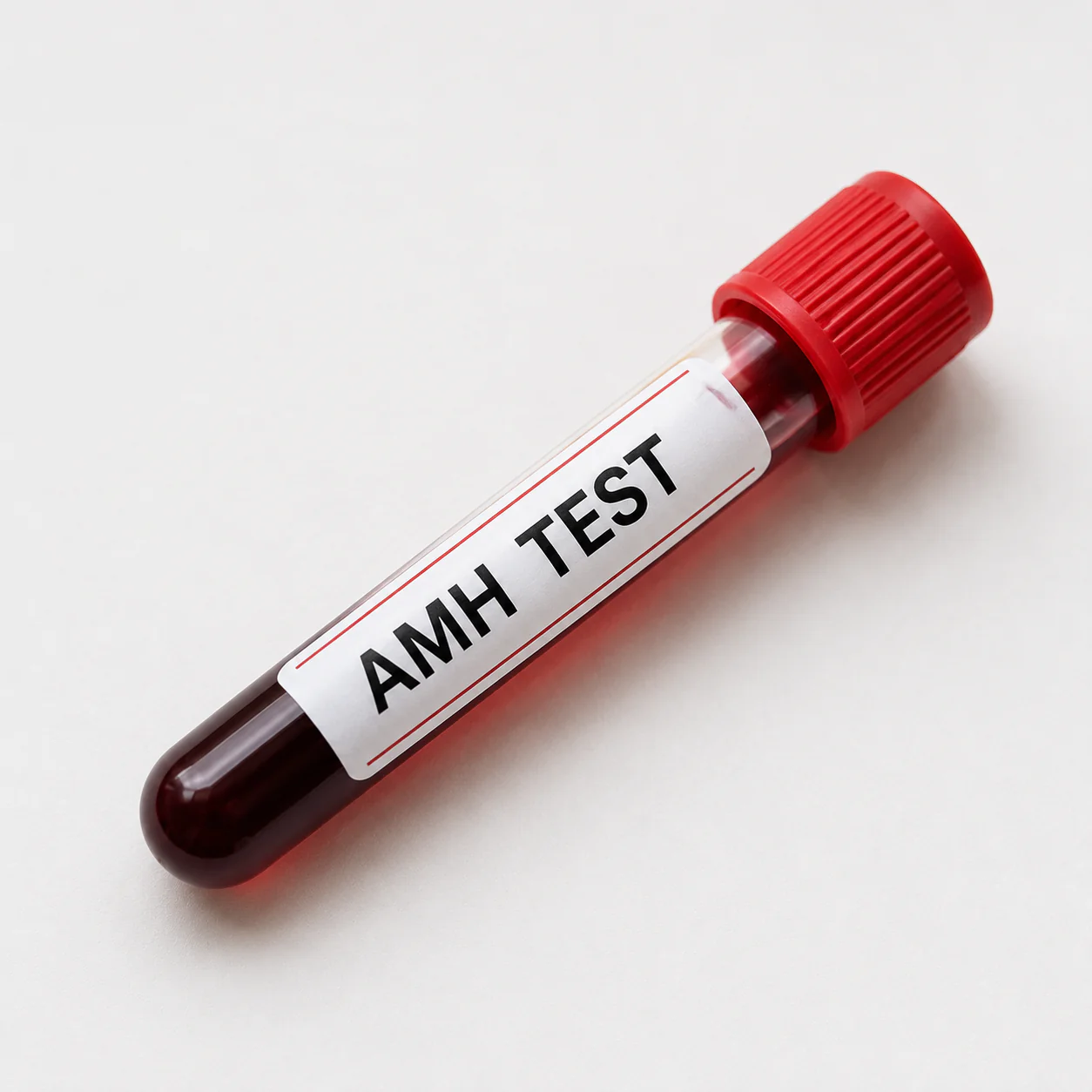
The AMH test Pakistan is a simple blood test that requires no fasting or special preparation. It is widely available in Lahore and other major cities and is commonly recommended for women planning pregnancy, undergoing fertility evaluation, or considering IVF treatment.
In Pakistan, the AMH test cost Pakistan generally ranges between PKR 4,000 and PKR 8,000, depending on the laboratory and city. At AAS Fertility & IVF Center, AMH results are always interpreted together with age, ultrasound findings, and other fertility investigations to provide a complete picture rather than relying on one test alone.
What is a Normal AMH Level? (Age-Wise Guide for Pakistani Women)
AMH levels naturally decline with age, so a lower result does not always indicate a fertility problem.
Below is a general guide used by fertility specialists.
| Age | Normal AMH Range |
|---|---|
| 20–25 years | 3.0 – 6.8 ng/ml (High / Optimal) |
| 26–30 years | 2.0 – 4.5 ng/ml (Good) |
| 31–35 years | 1.0 – 3.5 ng/ml (Average) |
| 36–40 years | 0.5 – 1.5 ng/ml (Low-Normal) |
| Above 40 years | Below 0.5 ng/ml (Low) |
These values are approximate and may vary slightly between laboratories.
One of the most important things to remember is that AMH naturally decreases as women grow older. This decline is part of the normal ageing process and does not necessarily indicate infertility.
For women planning IVF with low AMH Pakistan, fertility specialists generally consider AMH levels between 1.0 and 3.5 ng/ml favourable because they often predict a good response to ovarian stimulation medications. However, pregnancy is still possible even when AMH is lower than this range.
Your fertility specialist will always interpret AMH together with your age, menstrual history, ultrasound scan, and other fertility tests before recommending treatment.
What Causes Low AMH Levels in Pakistan?
Low AMH levels usually develop gradually and may occur for several different reasons.
Age
Age is the most common cause of low AMH. Women are born with all the eggs they will ever have, and this number naturally decreases over time, particularly after the age of 25.
Premature Ovarian Insufficiency
Some women experience reduced ovarian function earlier than expected. This condition, known as premature ovarian insufficiency, causes ovarian reserve to decline before the age of 40.
Previous Ovarian Surgery
Operations performed to remove ovarian cysts or treat endometriosis may reduce ovarian reserve by affecting healthy ovarian tissue.
PCOS
Interestingly, PCOS and high AMH often occur together. Women with Polycystic Ovary Syndrome usually have higher-than-normal AMH levels because they have a larger number of small follicles.
Genetic Factors
Certain inherited conditions may influence how quickly ovarian reserve declines. Family history can sometimes provide important clues about reproductive health.
Autoimmune Conditions
Some autoimmune disorders may affect ovarian function by causing the body’s immune system to mistakenly attack healthy ovarian tissue.
Smoking and Lifestyle
Smoking exposes the ovaries to harmful chemicals that may accelerate egg loss. Poor nutrition, obesity, and chronic stress can also negatively affect overall reproductive health.
Although these factors may reduce ovarian reserve, they do not automatically prevent pregnancy. Early diagnosis and appropriate fertility care can make a significant difference.
What Does Low AMH Actually Mean for Your Fertility?
Low AMH means fewer eggs remain in the ovaries, but it does not mean there are no eggs or that pregnancy is impossible.
This is one of the biggest misconceptions about AMH testing.
The AMH test measures egg quantity, not egg quality. A woman with low AMH may have fewer eggs available, yet those eggs can still be healthy enough to result in pregnancy.
For this reason, many women with low AMH conceive naturally, while others achieve successful pregnancies through IVF treatment.
Fertility specialists never rely on AMH alone. Instead, they combine it with several other important assessments, including:
- Follicle Stimulating Hormone (FSH) blood test
- Antral Follicle Count (AFC) ultrasound scan
- Age
- Menstrual history
- Overall reproductive health
Together, these tests provide a much clearer understanding of fertility potential.
Women with low ovarian reserve often respond differently to fertility medications, but many still produce healthy eggs during treatment. Even retrieving a small number of good-quality eggs can be enough to achieve pregnancy.
The most important message is one that every woman should remember:
Low AMH is not the same as infertility. It simply helps doctors choose the most appropriate treatment strategy and plan the best possible path toward pregnancy.
Can You Get Pregnant With Low AMH in Pakistan?
Yes. Many women with low AMH become pregnant naturally or through fertility treatment.
Although low AMH indicates a reduced ovarian reserve, it only takes one healthy egg to achieve a successful pregnancy. Many women become mothers despite having lower-than-average AMH levels.
At AAS Fertility & IVF Center, Dr. Naila Jabeen has helped numerous women with diminished ovarian reserve move closer to parenthood through individualized fertility care.
When natural conception becomes difficult, IVF offers another opportunity. Modern fertility medicine has advanced significantly, allowing specialists to tailor ovarian stimulation protocols according to each woman’s ovarian reserve.
Women with low AMH may benefit from mild stimulation or Mini IVF, which focuses on retrieving fewer but healthier eggs instead of aiming for a large number of eggs.
Every patient responds differently to treatment, which is why personalized fertility care is so important. Rather than focusing only on AMH numbers, experienced fertility specialists consider age, AFC, hormone levels, egg quality, and overall health before recommending treatment.
With timely diagnosis, expert guidance, and individualized care, many women with low AMH continue to achieve successful pregnancies and fulfill their dream of becoming mothers\
IVF With Low AMH — What to Expect at AAS Fertility Lahore
Women with low AMH require a personalized IVF approach because every ovarian reserve is different.
If your AMH level is low, your fertility specialist will carefully design an IVF treatment plan that suits your body rather than using a standard protocol. At AAS Fertility & IVF Center, every patient receives an individualized assessment before treatment begins.
The first step is a detailed fertility evaluation. Along with the AMH blood test, Antral Follicle Count (AFC) is performed through a transvaginal ultrasound. AFC measures the number of small follicles visible in the ovaries and helps estimate how many eggs may respond to stimulation medications.
Depending on your age, hormone levels, AFC, and medical history, Dr. Naila Jabeen may recommend a customized ovarian stimulation protocol. Some women require higher doses of fertility medications to encourage the ovaries to produce mature eggs, while others benefit from mild stimulation protocols that focus on obtaining fewer but healthier eggs.
One important fact often surprises patients: a successful pregnancy does not require dozens of eggs. Even retrieving two or three good-quality eggs can lead to healthy embryos and a successful pregnancy.
Throughout treatment, the team closely monitors follicle growth with ultrasound scans and blood tests to ensure the safest and most effective response.

At AAS Fertility & IVF Center, personalized IVF protocols are designed to maximize every opportunity while keeping treatment safe and patient-focused.
Learn more about our IVF treatment.
Natural Ways to Support Fertility With Low AMH
Although low AMH cannot be reversed, healthy lifestyle choices can support overall fertility and improve your body’s response to treatment.
DHEA Supplementation
Some women with diminished ovarian reserve may benefit from DHEA supplements, but they should only be taken under the supervision of a fertility specialist. Self-medication is not recommended.
CoQ10 Supplements
Coenzyme Q10 (CoQ10) is an antioxidant that may help support egg health by protecting cells from oxidative stress. Your doctor can advise whether it is suitable for you.
Manage Stress
Long-term stress increases cortisol, a hormone that may interfere with normal reproductive hormone balance. Relaxation techniques, gentle exercise, and emotional support can improve overall well-being during fertility treatment.
Eat an Antioxidant-Rich Diet
A healthy diet rich in berries, leafy green vegetables, citrus fruits, nuts, seeds, whole grains, and lean protein provides nutrients that support reproductive health.
Avoid Smoking
Smoking accelerates the loss of ovarian reserve and exposes eggs to harmful toxins. Quitting smoking is one of the most effective lifestyle changes for protecting fertility.
Maintain a Healthy Weight
Being significantly underweight or overweight can affect hormone balance and ovulation. Achieving a healthy body weight supports both natural conception and IVF outcomes.
While these habits cannot increase AMH levels, they can help create the healthiest possible environment for pregnancy.
Why Choose AAS Fertility & IVF Center for Low AMH Treatment in Lahore?
Choosing an experienced fertility specialist is especially important when ovarian reserve is low.
At AAS Fertility & IVF Center, every woman receives compassionate, evidence-based care tailored to her individual fertility needs. Led by Dr. Naila Jabeen, one of Pakistan’s experienced IVF specialists, the center provides advanced fertility treatments using modern reproductive technology and personalized protocols.
Conveniently located at Chohan Tower, 16 Jail Road, Shadman II, Lahore, AAS Fertility has earned the trust of couples across Pakistan through ethical medical care, transparent guidance, and patient-centered treatment.
Services include:
- IVF treatment
- IUI treatment
- ICSI
- Micro TESE
- Embryo Banking
- PGT-A
- Laparoscopy
- Ovulation Induction
- Comprehensive fertility testing
For women with low ovarian reserve, treatment protocols are carefully adjusted to maximize egg retrieval while maintaining patient safety. Every fertility journey is unique, and every treatment plan reflects that philosophy.
As one of the best IVF & IUI centers in Pakistan, AAS Fertility combines advanced medical expertise with compassionate support to help couples move confidently toward parenthood.
Book your free consultation with Dr. Naila Jabeen today
Frequently Asked Questions About Low AMH in Pakistan
Q: What is a low AMH level in Pakistan?
A: In general, an AMH level below 1.0 ng/ml is considered low, while levels below 0.5 ng/ml indicate significantly reduced ovarian reserve. Results should always be interpreted by a fertility specialist.
Q: Can I get pregnant naturally with low AMH?
A: Yes. Many women with low AMH conceive naturally. Low AMH indicates fewer eggs, not poor egg quality or complete infertility.
Q: What is the AMH test cost in Lahore, Pakistan?
A: The AMH test usually costs between PKR 4,000 and PKR 8,000. AAS Fertility & IVF Center also provides expert fertility consultation to interpret your results accurately.
Q: Does low AMH mean I need IVF?
A: Not always. Treatment depends on your age, ovarian reserve, partner’s fertility, and overall reproductive health. Some women conceive naturally or with simpler fertility treatments.
Q: Can low AMH levels improve naturally?
A: AMH levels usually cannot be increased naturally. However, healthy lifestyle choices and appropriate medical treatment can improve your chances of pregnancy.
Q: Which is the best clinic for low AMH treatment in Lahore?
A: AAS Fertility & IVF Center, led by Dr. Naila Jabeen, provides personalized fertility care for women with low AMH at Chohan Tower, 16 Jail Road, Shadman II, Lahore.
Conclusion
Low AMH can feel worrying, but it is not the end of your fertility journey. It simply means your ovarian reserve is lower than average—not that pregnancy is impossible. Many women with low AMH have conceived naturally, while others have achieved successful pregnancies through personalized fertility treatment and IVF. Early evaluation, expert guidance, and the right treatment plan can make a meaningful difference.
In Summary: Low AMH measures the number of eggs remaining in the ovaries, not the quality of those eggs. Pregnancy is still possible with low AMH, and many women become mothers through natural conception or IVF. Personalized treatment, age, overall reproductive health, and timely medical care are the key factors that influence success.
Contact AAS Fertility & IVF Center in Lahore—Pakistan’s trusted IVF specialists