Can you get pregnant on your period? Yes, it is possible, but it is uncommon. The bleeding itself is not the cause. Sperm can survive inside the body for up to five days, so if you ovulate soon after your period, they can still be there to meet the egg.
Your chance of getting pregnant on your period is higher if your cycle is short (about 24 days or less), your period is long (7 days or more), or your cycles are irregular. No time of the month is completely safe without contraception.
This guide, from the team at AAS Fertility & IVF Center in Lahore, explains how it happens, who is more likely to conceive, how to tell a period from other bleeding, and what to do next. The NHS also confirms there is no completely safe time of the month to have sex without contraception.
How your cycle and fertile window work
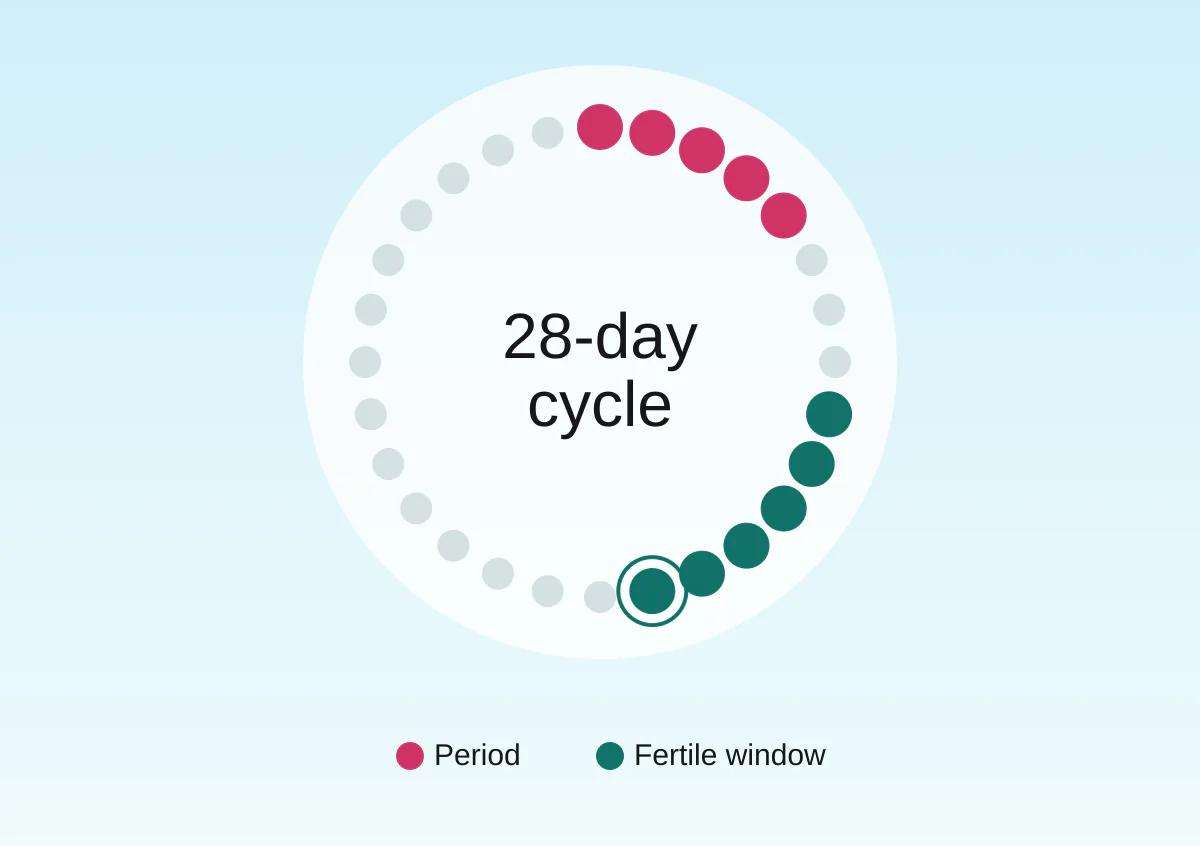
Your cycle is counted from the first day of bleeding to the day before your next period starts. 28 days is the textbook average, but healthy cycles range from roughly 21 to 35 days.
Ovulation, when an ovary releases an egg, usually happens about 12 to 14 days before your next period. The egg survives only 12 to 24 hours, while sperm can survive up to five days. That gives you a fertile window of about six days: the five days before ovulation, plus ovulation day.
The shorter your cycle, the closer that window sits to your period:
| Cycle length | Usual ovulation day | Fertile window (approx.) | Overlap with a 5 to 7 day period |
|---|---|---|---|
| 21 days | Day 7 | Days 2 to 7 | Yes, likely |
| 24 days | Day 10 | Days 5 to 10 | Possible at the end of the period |
| 28 days | Day 14 | Days 9 to 14 | Very unlikely |
| 35 days | Day 21 | Days 16 to 21 | No |
These are estimates. Ovulation can move from one cycle to the next, so use the table as a guide, not a calendar you can rely on.
How you can get pregnant on your period
You cannot ovulate while you are having a true period, so pregnancy does not happen on the spot. It happens in three steps:
- You have unprotected sex on a later day of your period, when flow is light.
- Sperm survive in the reproductive tract, helped by fertile cervical mucus, for up to five days.
- You ovulate earlier than expected, and a sperm is still there when the egg is released.
The risk rises with each day of the period. Sex on day 1 or 2, when flow is heaviest and ovulation is furthest away, carries the lowest risk. Sex on the last days of a long period, followed by early ovulation, carries the highest.
So, can you get pregnant on your period? Yes. A period is not a form of contraception, and there is no “safe” day of the cycle if you want to avoid pregnancy.
Who is more likely to get pregnant on their period
Pregnancy from period sex is mostly a story about timing, so these groups have a higher chance:
- Short cycles. If your cycle is about 24 days or less, ovulation can fall within days of your period ending.
- Long periods. Bleeding for 7 days or more means sex late in the period sits close to the fertile window.
- Irregular cycles. When ovulation is hard to predict, as in PCOS or thyroid problems, any day can fall near it. See our guides on irregular periods and fertility and pregnancy with PCOS.
- After a birth or miscarriage. Ovulation can return before your first period does, so you can conceive before you see any bleeding.
- Recently stopped hormonal contraception. It can take a few cycles for a regular pattern to return.
Is it your period, ovulation spotting or implantation bleeding?
Not all vaginal bleeding is a period. If you had unprotected sex and your “period” looks unusual, compare it with this table:
| True period | Ovulation spotting | Implantation bleeding | |
|---|---|---|---|
| When | Start of the cycle | Mid-cycle, around ovulation | About a week before your expected period, if you conceived |
| Flow | Moderate to heavy, builds up | Very light, spotting only | Very light, spotting only |
| Colour | Bright to dark red | Pink or light brown | Pink or brown |
| Lasts | 3 to 7 days | 1 to 2 days | A few hours to 2 days |
A true period cannot happen during pregnancy. If your next period is lighter or shorter than usual, or comes at an odd time, take a pregnancy test. Severe one-sided pain with bleeding needs urgent medical care, because it can signal an ectopic pregnancy.
Periods mein hamal thehr sakta hai? (Roman Urdu summary)
Jee haan, lekin imkaan kam hota hai. Sperm aurat ke jism mein 5 din tak zinda reh sakta hai. Is liye agar periods ke aakhri dinon mein ta’luq ho aur ovulation jaldi ho jaye, to hamal ho sakta hai. Yeh khaas taur par un khawateen mein hota hai jin ki cycle chhoti ho (24 din ya kam), periods lambe hon, ya cycle be-tarteeb ho.
Periods koi mehfooz waqt nahi hain. Agar abhi hamal nahi chahtay to contraception istemal karein. Agar hamal chahtay hain aur 12 mahine koshish ke baad (35 saal se zyada umar mein 6 mahine) bhi nahi ho raha, to fertility specialist se mashwara karein.
If you are trying to conceive: time sex around ovulation, not your period
If your goal is pregnancy, your best chances come in the days before ovulation, not during your period. Our guide on how often couples should try to conceive explains how frequently to have sex.
- Have sex every 1 to 2 days from the end of your period through the days around ovulation. You do not need to time it to the hour.
- Track your cycle. Note the first day of each period for a few months to learn your usual length. Our guides on finding your fertile window and tracking ovulation explain the methods.
- Watch for fertile mucus. Clear, stretchy mucus like raw egg white usually appears just before ovulation.
- Use ovulation test kits as a guide. They detect the hormone surge that comes before ovulation, but they are not perfect, so do not rely on one alone.
- Start folic acid before you conceive. Ask your doctor about the right dose for you.
- Avoid smoking, which can reduce fertility in both partners.
When to see a fertility specialist
See a specialist if you have been trying with regular unprotected sex for 12 months (under 35) or 6 months (35 or older) without a pregnancy. Go sooner if:
- your periods are irregular, very infrequent or absent
- your periods are very painful or very heavy
- you have PCOS, endometriosis, fibroids or a past pelvic infection
- your partner has a known low sperm count or has had testicular surgery
- you are 40 or older
Our guides on when to visit a fertility doctor and the fertility test guide explain what the first assessment involves.
At AAS Fertility & IVF Center, Chohan Tower, 16 Jail Road, Shadman II, Lahore, your first consultation is free. Call or WhatsApp +92 311 1100251, or book a consultation.
Frequently asked questions
Can you get pregnant on the first day of your period?
It is very unlikely. Ovulation is usually many days away, and sperm survive only up to five days. It is only conceivable with an unusually short cycle.
Can you get pregnant on the last day of your period?
Yes, this is more likely than on the first day. If you ovulate within about five days, sperm from that day can still be present, especially with a short cycle.
Can you get pregnant right after your period?
Yes. Your fertile window can begin within days of your period ending, even though you are not ovulating yet.
Can you get pregnant the day before your period?
It is extremely unlikely. The egg survives only 12 to 24 hours after ovulation, and ovulation normally happens about two weeks before the next period.
Does period blood wash sperm away?
No. Menstrual flow does not stop sperm from entering the cervix, and they can survive for days.
Can you get pregnant on your period while on birth control?
It is uncommon if you use it correctly, but missed pills, vomiting or a late injection can lower protection. Ask your doctor about your method.
Can you be pregnant and still have a period?
A true period cannot happen during pregnancy, but light bleeding can occur in early pregnancy and be mistaken for one. Take a pregnancy test if your period seems unusual. Heavy bleeding or severe pain needs urgent medical care.
Conclusion
Can you get pregnant on your period? Yes, but it is unlikely, and the risk depends on your cycle length, how long you bleed and when you ovulate. If you want to avoid pregnancy, use contraception in every cycle. If you want to conceive, aim for the days before ovulation, and see a specialist if it is taking longer than expected. Book consultation at AAS Fertility & IVF Center in Lahore.