ICSI vs IVF: the short answer
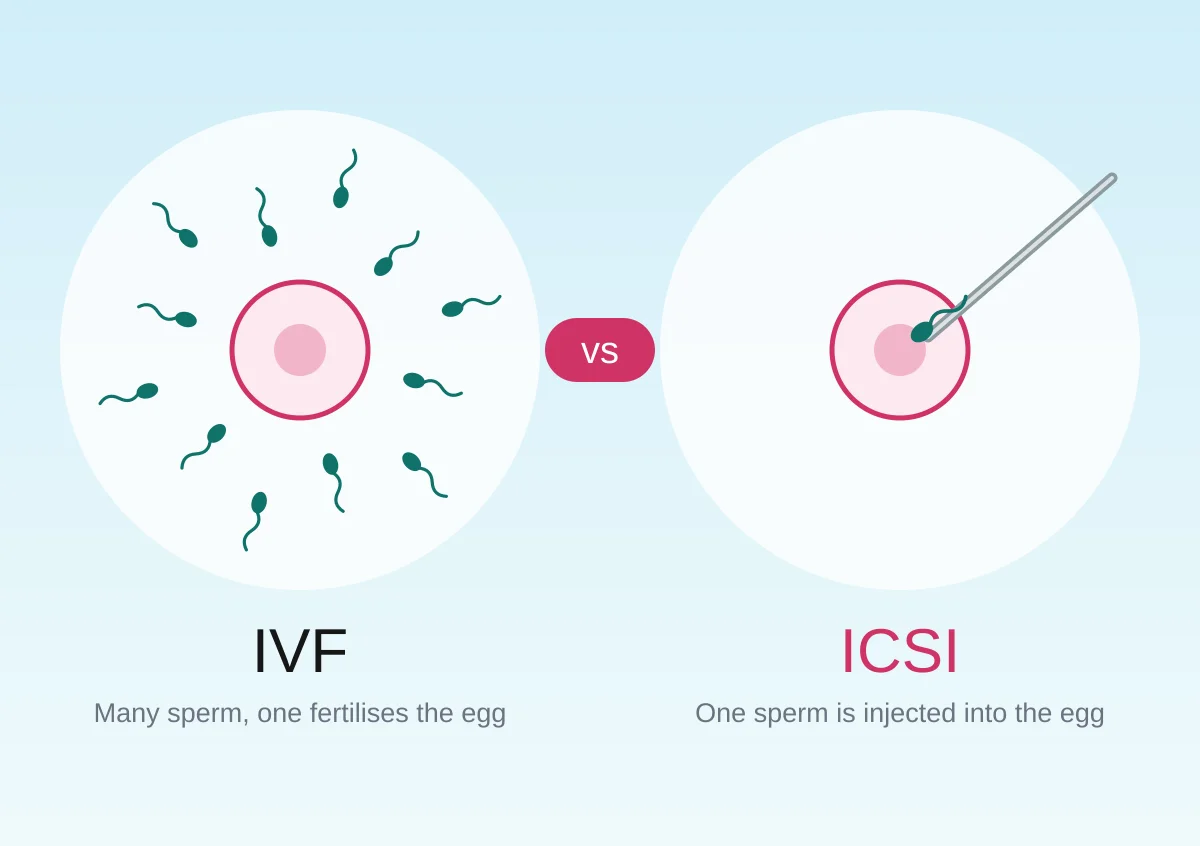
ICSI vs IVF is not a choice between two separate treatments. ICSI (intracytoplasmic sperm injection) is a way of fertilising the egg inside an IVF cycle. In standard IVF, thousands of sperm are placed with the eggs in a dish and one fertilises an egg on its own. In ICSI, an embryologist picks a single sperm and injects it directly into each egg.
Everything else is the same: ovarian stimulation, egg collection, embryo culture and embryo transfer. Your doctor recommends ICSI mainly when there is a male-factor problem or when fertilisation failed in an earlier cycle.
This guide, from the team at AAS Fertility & IVF Center in Lahore, explains the difference, who needs ICSI, how success rates and costs compare, and what to ask your doctor.
What are IVF and ICSI?
IVF (in vitro fertilisation) means the egg is fertilised by sperm outside the body, in the laboratory. In Pakistan it is often called “test tube baby” treatment. The steps are:
- Medicines stimulate the ovaries to produce several eggs.
- The eggs are collected with a thin needle under ultrasound guidance.
- The eggs and sperm are brought together in the lab.
- The embryos are grown for a few days and one is transferred to the womb.
You can read each step in our guides to the IVF process and the test tube baby procedure.
ICSI changes only step 3. Instead of leaving the sperm to find the egg, the embryologist uses a very fine needle to place one healthy-looking sperm inside each mature egg. The embryo is then grown and transferred in exactly the same way. When a clinic says a couple is “having ICSI”, it means IVF with ICSI as the fertilisation method. Learn more about ICSI treatment in Lahore at our center.
ICSI vs IVF at a glance
| Conventional IVF | IVF with ICSI | |
|---|---|---|
| How the egg is fertilised | Sperm and eggs are placed together in a dish and fertilise naturally | One sperm is injected into each mature egg |
| Sperm needed | Many healthy, moving sperm | One viable sperm per egg |
| Usually recommended for | Female-factor causes, tubal problems, unexplained infertility, normal semen | Low sperm count, poor movement or shape, sperm retrieved by surgery, failed fertilisation before |
| Stimulation, egg collection, transfer | Same | Same |
| Lab work | Standard | Extra step by an embryologist, which is why it usually costs more |
| Chance of success when semen is normal | Similar | Similar, with no proven advantage |
The last row matters. ICSI is a tool for a specific problem. It does not make IVF work better when sperm are not the problem.
Who needs ICSI, and who can have conventional IVF?
Your doctor may recommend ICSI if:
- the semen analysis shows a low sperm count, poor movement or an abnormal shape (see our guide to the signs of low sperm count)
- sperm were retrieved surgically, for example after a diagnosis of azoospermia, where there is no sperm in the semen
- very few eggs were collected, so every egg needs the best chance of fertilising
- eggs failed to fertilise in a previous conventional IVF cycle (see failed IVF)
- the sperm were frozen and have limited quality after thawing
- embryos will be tested with PGT-A, because many labs use ICSI for genetic testing
Conventional IVF is usually enough when semen parameters are normal and the cause is on the female side, such as blocked tubes, ovulation problems or endometriosis, or when no cause is found.
The decision is made case by case, after both partners are assessed. Our guide to male infertility treatment explains what that assessment looks like.
Is ICSI better than IVF? Success rates and safety
Not automatically. When male-factor infertility is not the problem, conventional IVF and ICSI have similar success rates. Your age, egg quality, sperm quality and medical history matter far more than the fertilisation method. For ICSI, the benefit is that it makes fertilisation possible when sperm numbers or quality are low.
Safety is also similar, because the medicines, egg collection and transfer are the same. Our guide to IVF risks and safety covers them. Two points are specific to ICSI:
- A small number of eggs can be damaged during the injection.
- ICSI is often used for severe male infertility, and some causes of it can be genetic. Your doctor may advise genetic testing for the man before treatment.
ICSI cannot choose a baby’s sex. Success depends on many factors, and no clinic can promise a result. For general figures see our page on IVF success rates.
ICSI cost in Lahore: what changes the price
ICSI usually costs more than conventional IVF because it needs extra laboratory work by an embryologist. The total depends on:
- the number of eggs collected and how many are injected
- your medicines, which vary with your age and ovarian response
- whether sperm are retrieved by surgery first
- whether you add embryo freezing or PGT-A
- any repeat cycle or frozen transfer
Because these vary from couple to couple, ask for an itemised quote that shows the ICSI charge separately from the IVF cycle, the medicines and any extras. Our IVF cost in Lahore guide explains what a cycle usually includes.
ICSI aur IVF mein farq (Roman Urdu summary)
ICSI aur IVF do alag ilaaj nahi hain. ICSI, IVF ka hi ek tareeqa hai. Aam IVF mein lab ki dish mein anday aur bohat se sperm saath rakhe jaate hain aur sperm khud anday mein dakhil hota hai. ICSI mein embryologist ek achha sperm chun kar seedha anday ke andar daal deta hai.
Baaqi tamam marahil wahi rehte hain: dawaiyan, anday nikalna, embryo ka barhna aur transfer. ICSI aam taur par tab kiya jaata hai jab sperm kam hon, un ki harkat ya shakal theek na ho, ya pehle IVF mein fertilisation na hui ho. Agar sperm theek hon to ICSI se kamyabi ka imkaan zyada nahi hota.
Kaun sa tareeqa munasib hai, yeh doctor dono shauhar aur biwi ke muayene ke baad batati hain. ICSI ka kharch aam IVF se aksar zyada hota hai, is liye itemised quote zaroor lein.
How to decide between ICSI and IVF with your doctor
You do not choose between ICSI and IVF on your own. Come to your consultation with these questions:
- What does my partner’s semen analysis show, and is ICSI needed because of it?
- If our semen results are normal, is there any reason to add ICSI?
- Will you inject every egg, or only some of them?
- What is the ICSI charge, and is it listed separately in the quote?
- Do we need any genetic tests before treatment?
- What happens if fertilisation is low?
See a specialist if you have been trying for 12 months (6 months if the woman is 35 or older), or sooner if there is a known sperm problem, blocked tubes or irregular periods. Our fertility test guide explains the first tests.
At AAS Fertility & IVF Center, Chohan Tower, 16 Jail Road, Shadman II, Lahore, your first consultation is free. Call or WhatsApp +92 311 1100251, or book a consultation.
Frequently asked questions about ICSI vs IVF
Is ICSI better than IVF?
No, not in general. ICSI is better only when sperm quality or number is the problem. With normal semen, both methods have similar success rates.
Is ICSI the same as a test tube baby?
ICSI is a form of IVF, and in Pakistan “test tube baby” usually means IVF in general. A baby conceived with ICSI is conceived in the lab like any IVF baby.
Is ICSI painful?
The injection happens in the laboratory, not in your body, so you feel nothing. The discomfort of treatment comes from the injections and egg collection, which are the same as in standard IVF.
Does ICSI choose a boy or a girl?
No. ICSI does not select a baby’s sex. Embryo testing such as PGT-A is a separate procedure.
Can we have ICSI if the semen analysis is normal?
Yes, but it is not usually needed. Some doctors suggest it after a previous cycle with failed fertilisation. Ask why it is being recommended.
Does ICSI cost more than IVF?
Usually yes, because of the extra laboratory work. Ask for an itemised quote.
Is the ICSI procedure safe?
It carries the same risks as IVF, plus a small chance that an egg is damaged during injection. Your doctor will explain the risks for your situation.
Conclusion
ICSI vs IVF comes down to one step: how the egg is fertilised. ICSI is the right tool when sperm quality or number is the problem, and standard IVF is usually enough when it is not. Whichever you need, the rest of the treatment is the same, and the decision should follow a full assessment of both partners. Book a free consultation at AAS Fertility & IVF Center in Lahore to find out which suits you.
Sources
- Acıbadem International: “ICSI vs IVF: the difference and when ICSI is chosen”
- European Sperm Bank: “ICSI vs. IVF: understanding the key differences”
- Apollo Fertility: “Comparing ICSI and IVF procedure”
- MedlinePlus: “In vitro fertilization”
This is general information, not a diagnosis or a substitute for a consultation.